



Monogastrics
•
4 min read
Fats: Digestion and Absorption
How fats are digested and used in pigs and poultry, when to include them in the diet, and which lipid profiles to apply depending on the production goal.

Fats in monogastrics
Fats do not only supply energy: when properly selected, they help optimize productive performance and feed efficiency, and they allow you to target specific objectives (growth, reproduction, carcass quality, gut health).
Content based on the "Monogastrics" technical sheet (Nutrion Internacional).
Digestion and absorption
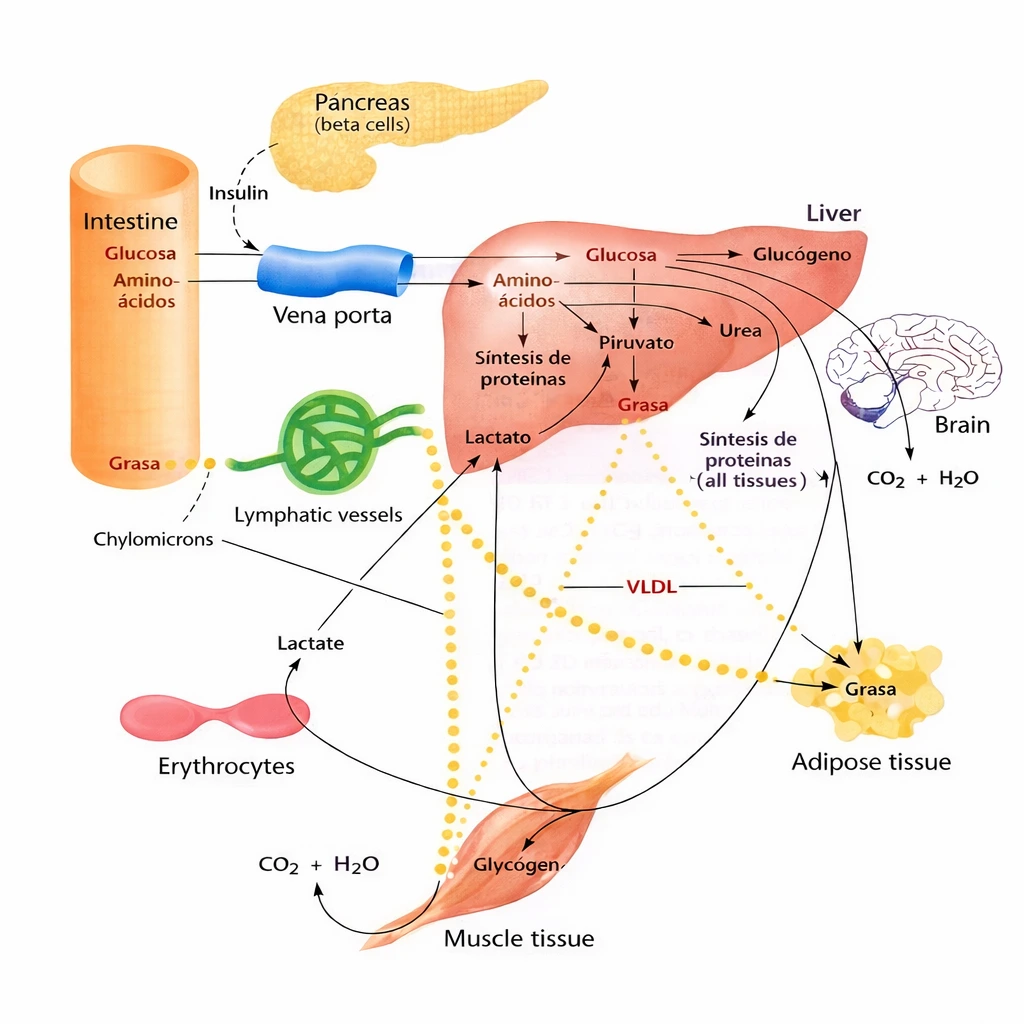
- Emulsification begins in the stomach thanks to peristaltic movements.
- In the duodenum, lipids are hydrolyzed by the combined action of pancreatic lipases and bile salts, reducing fat particle size and facilitating enzymatic action.
- Micelles are formed (monoglycerides + fatty acids + bile salts), which transport lipids to intestinal cells for absorption.
Metabolism and utilization
- Lipids are absorbed as triglycerides and lipoproteins that enter the bloodstream.
- In the mammary gland, lipids can be converted into milk fat.
- Beta-oxidation of fatty acids produces energy (e.g., palmitic acid → 129 ATP).
Lipid synthesis: pigs vs poultry
Pigs
- Adipose tissue is the main site of de novo lipid synthesis, using glucose as a precursor.
- Fat deposition typically follows the order: subcutaneous → intermuscular → intramuscular.
- It depends more on age than on body weight.
Poultry
- Lipogenesis is mainly hepatic (in the liver).
- It requires triglyceride transport via lipoproteins.
When to include fats?
Starter feed
Include 3–4%
- Improves pelleting of the diets.
- Although digestibility is limited before 35 days, it increases with age.
Finishing / grow-out
Include 1–6%
- Improves average daily gain (ADG).
- Optimizes feed efficiency.
- No negative effects on backfat.
Gestation
Supplement at the end of gestation
- Minimizes loss of body condition.
- Benefits productive performance.
- Increases litter growth.
Lactation
Add 3–5%
- Increases the energy density of the diet.
- Improves milk production and milk fat.
- Beneficial for sow health.
- Increases piglet survival.
Practical note: vegetable fats usually provide a more unsaturated profile; animal fats tend to be more saturated and firmer. The choice affects usable energy and carcass quality.
Saturated fats and oils: key points
- Saturated fats usually result in a firmer fat.
- Deposited fat tends to reflect the dietary fatty acid profile.
- Fats and oils provide approximately 2.25× more energy than proteins and carbohydrates.
- The heat associated with fat digestion is lower than that of proteins and carbohydrates, helping maintain performance.
Including EFA (Essential Fatty Acids)
Why supplement?
- There is endogenous synthesis, but it is very low.
- Only 5% of C18:3 is converted into EPA and DHA.
Main families
| Family | Fatty acids |
|---|---|
| Omega 6 | Linoleic acid LA (C18:2 ω6) → ARA (C20:4 ω6) |
| Omega 3 | Linolenic acid ALA (C18:3 ω3) → EPA (C20:5 ω3) → DHA (C22:6 ω3) |
Our products for monogastrics (overview)




RUMINER (calcium salts, PFAD base)
A calcium salt obtained by the reaction between two fatty acids and a calcium ion through a saponification process.
Origin: calcium salts of free fatty acids from palm oil (PFAD, Palm Fatty Acid Distillate).
Benefits (summary)
- Increase in unsaturated fats → healthier profile.
- Does not affect carcass performance.
- Improves the feed conversion index.
Nutritional values
| Parameter | Value |
|---|---|
| Fat | 84% min |
| Ash | 12% min |
| Moisture | 3% min |
| Calcium | 9% |
Fatty acid profile
| Fatty acid | Range |
|---|---|
| C16:0 | 43–52% |
| C18:0 | 3–6% |
| C18:1 | 30–40% |
| C18:2 | 5–11% |
In monogastrics
- Swine / Poultry: no negative effects on productive performance; improves FCR and ADG, increases piglet weight, and reduces weight loss during lactation.
RUMINER ω3 (calcium salts: fish + flaxseed)
Calcium salts of fatty acids from fish oil and flaxseed oil. Contains polyunsaturated fatty acids:
- Linolenic ALA (C18:3)
- Eicosapentaenoic EPA (C20:5)
- Docosahexaenoic DHA (C22:6)
Profile (summary)
| Indicator | Value |
|---|---|
| ≤C14:0 | <5% |
| EPA + DHA | 20–22% |
| Omega 3 | 25–30% |
| Omega 6 | 3–7% |
Benefits in swine
- Increased weaning weight.
- Reduced weaning-to-estrus interval.
- Increased breeding and pregnancy rate.
- Reduced piglet mortality.
- Increased litter size.
- + DHA: stimulates piglet neurological development.
- Increased post-weaning growth.
- Improved palatability → higher feed intake.
- Improved immune system.
- Improved fatty acid profile.
- Improved boar semen concentration and quality.
RUMINER ω6 (calcium salts: vegetable blend rich in omega 6)
Calcium salts from a blend of vegetable oils rich in omega 6.
Fatty acid profile
| Fatty acid | Range |
|---|---|
| C16:0 | 10–14% |
| C18:0 | 4–6% |
| C18:1 | 28–37% |
| C18:2 | 45–55% |
Benefits
- Increased litter size.
- Increased milk production.
- Increased milk fat content.
- Increased piglet growth.
- High stability against oxidation.
RUMINER ω9 (calcium salts: olive oil)
Calcium salts of fatty acids from olive oil.
Modifies the fatty acid profile of milk fat → healthier for human consumption.
Nutritional values
| Parameter | Value |
|---|---|
| Fat | 72.5% min |
| Ash | 11.8% |
| Moisture | 10.5% |
| Calcium | 6% min |
Fatty acid profile
| Fatty acid | Range |
|---|---|
| C16:0 | 12–20% |
| C18:0 | 3–5% |
| C18:1 | 64–70% |
| C18:2 | 9–15% |
Applications (summary)
- Iberian pig: increases energy density, ideal profile, greater intramuscular fat/infiltration, improves meat handling, without affecting palatability.
- Calves: improves final weight and yield, improves marbling, increases carcass quality and scoring.
MONOFAT CC (calcium salts: coconut/palm kernel)
Calcium salts of fatty acids from coconut/palm kernel.
High in medium-chain and short-chain fatty acids. Indicated for piglet feeding:
- Milk replacers / lacto-starters
- Pre-starter feeds
- Starter feeds
Benefits
- Increases feed energy density.
- High digestibility due to its fatty acid profile.
- Improves productive indices (ADG and FCR).
- Improves health status.
- Easy handling and mixing (coarse powder).
- Stable product, fully inert.
Nutritional values
| Parameter | Value |
|---|---|
| Fat | 72.5% min |
| Ash | 11.8% min |
| Moisture | 10% max |
| Calcium | 6% min |
Profile
| Indicator | Value |
|---|---|
| C16:0 | 15–20% |
| C18:0 | 6–10% |
| C18:1 | 15–20% |
| MCFAs | >60% |
LIPIBIOTIC (MCFAs: C6–C12)
Supplement obtained from a blend of medium-chain fatty acids (MCFAs):
- Caproic / hexanoic acid C6:0
- Caprylic / octanoic acid C8:0
- Capric / decanoic acid C10:0
- Lauric / dodecanoic acid C12:0
Benefits
- Bactericidal and bacteriostatic.
- Improves the immune system.
- Reduces antibiotic use.
- Prevents metabolic disorders.
- Improves digestibility.
- Improves feed conversion.
- Reduces somatic cell count.
- Improves overall animal health.
Nutritional values
| Parameter | Value |
|---|---|
| Fat | 48% min |
| Ash | 51.5% min |
| Moisture | 1.5% min |
| Calcium | 2% |
Want help choosing the ideal profile?
Maximize your field results with precision nutrition. Select your species and production goal (growth, gut health, or carcass quality) to receive a nutritional plan designed for peak performance.